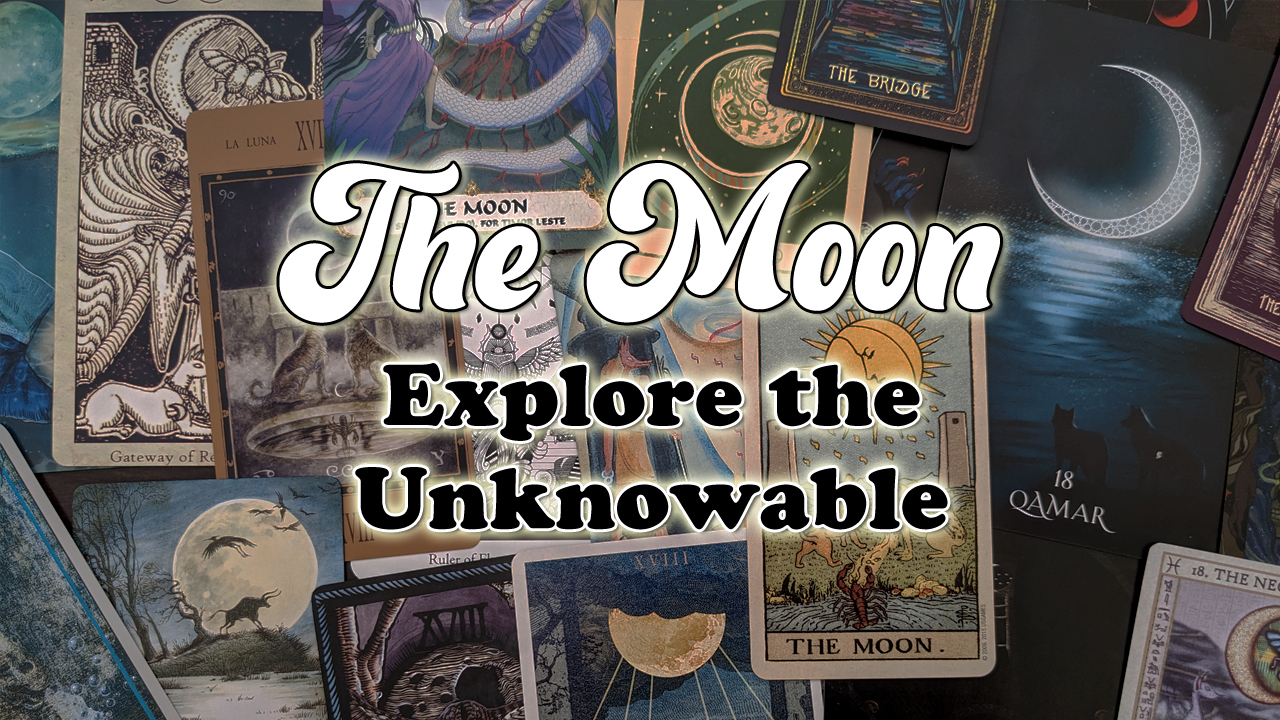
Delve into The Moon card’s profound wisdom on the subconscious, afterlife, and life’s mysteries. Embrace the unknown with us!
This card is part of the Major Arcana, which means the lessons it’s teaching are about a pathways we choose to take on our way towards improving our quality of life. Within the Major Arcana, The Moon card is part of the last leg of the journey towards enlightenment, part of the final path towards ascending to a higher self where we explore and master universal principles.
The lessons from The Moon card are about our personal explorations into the unknown, or really, the unknowable. This is our efforts to understand the intangible, to understand that which cannot be seen, heard, or touched directly.
The moon is the representative of this concept because it can be used as a means to see sunlight indirectly. As an astral body, the moon does not itself give off any light, it in fact reflects sunlight back towards the earth. The moon can be used as a tool to indirectly observe the light of the sun. Just as the real moon can be used to indirectly observe the light of the sun, The Moon card in tarot is teaching us to use indirect means to learn about the unknowable.
What are some things that are unknowable that we try to understand? The big unknowable of life is what occurs upon death. The biggest mystery of life is what is beyond our material existence. What existed before our material plane? What triggered the big bang that brought in our creation? So, The Moon card represents our exploration into God, The Divine, and spirituality. We can’t know these things directly, and so we take an indirect path to gain a glimpse of understanding these concepts.
We also have a part of ourselves that we struggle to truly know: Our own minds. Some of us can “see” within our mind, but we’re not actually seeing with our eyes, are we? What senses are being used in the mind? Those are our conscious thoughts. We also have our subconscious mind, composed of our emotions and impulses, and that which creates our dreams at night. So, The Moon card also represents our inner explorations to understanding ourselves, both our conscious minds and our subconscious motivations.
Let’s see how different decks approach the lessons of The Moon card.
Rider Waite Smith
We’re going to start off with the Rider Waite Smith deck, the deck that is the major player of modern tarot philosophy. This particular deck sheds light on various western cultural teachings from the middle ages to the late 1800’s.

The Moon card in the Waite Smith deck focuses on how our subconscious impulses influences our conscious thoughts and actions. The path Waite Smith recommends we take is to acknowledge and face our primal animal natures.
Western culture encourages repressing the animal-like nature of ourselves, which in many people ends up creating a “shadow self” that we become ashamed of, or even afraid of. The path The Moon card wants us to take is to stop repressing any aspects of ourselves. This path is to face your shame, face your fears, and then embrace and accept that these are parts of yourself so that you can ultimately embrace and accept all of yourself.
Urban Tarot
Urban Tarot shows us how the lessons of tarot apply to modern day-to-day life as witnessed in New York City.
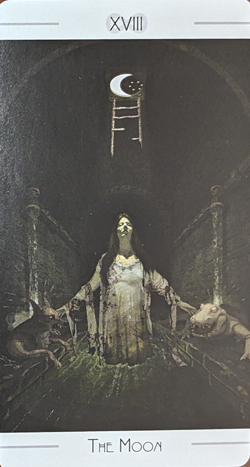
The Moon Card in the Urban Tarot deck is drawing a connection that diving deep into our own psyche would be like taking a trip down into a city’s sewers. The journey could be gross and uncomfortable with a constant urge to put a stop to this exploration and get out of there! It could be downright scary because you have a sense there could be beasts lurking in the dark and muck. You’re not only afraid of being contaminated by the utter filth of the place, but nervous something is going to jump out and surprise you, and possibly cause injury or to be consumed entirely!
It is no wonder people avoid taking a journey into their own subconscious. The experience could leave us covered in a filth, which would be like triggering an emotion and having it linger on in our body for a period of time. There can also be a danger that one of these triggered emotions could consume us and send us spiraling into an anxiety attack, or depression attack, or triggering a post-traumatic episode that could last days, weeks or even months.
Light Seer’s Tarot
Here is the Light Seer’s Tarot, which I find addresses western mysticism through a modern lens, making it more up front and understandable to the masses.

The Moon card in the Light Seer’s deck is focusing on the frustrating experiences we have when we struggle to understand the unknowable, when truth is obscured by distortions, or when we are faced with uncertainty. Our innate impulse is to struggle and fight against the lack of clarity, but that struggling and fighting could be like flailing when within a body of water: it can completely work against us and ultimately cause us to drown.
The Light Seer’s deck is teaching us to instead be calm when face to face with an obscured truth. Completely release your frustrations, stop struggling, and allow yourself to drift upwards. You will eventually surface to the truth.
Truths can be uncovered within ourselves by our intuition. Imagine the imagery of this card being instead about a sensory tank, where you close your eyes and float in complete darkness. You hear nothing. You smell nothing. You touch nothing. You are alone with your conscious and unconscious minds. While in this state, turn down the volume of your conscious mind and listen carefully to the messages of your subconscious. Be calm, don’t struggle. Find comfort in the darkness of your mind and wait for your subconscious to speak to you. It very well could understand truths your conscious mind does not yet know.
Spirit Keeper’s Tarot
The Spirit Keeper’s Tarot approach is to personify each card, as if there is a spirit entity that is represented by each of the 78 tarot cards. You approach understanding a card as you would trying to understand a person who will have their own goals, motivations, and methods for working with others.

The Moon card in the Spirit Keeper’s deck is personified as a spirit called The Necromancer. Here, the focus is on the cycle of life and death, and the Necromancer’s job is to resurrect that which has died. This card discusses the mysteries that require sense beyond the physical to solve, such as the mystery of existence after death.
When you die, Anubis balances your heart on a scale to see if you have lived a worthy life. Do you live a worthy life? What does it mean to live a worthy life? If you want to be weighed as worthy you’ll need to find answers to these questions. But the answers will never be clear, because we cannot clearly know what was wanted from our life when we enter the afterlife.
Thoth Tarot
The Thoth Tarot is sort of a cousin to the Rider Waite Smith and is also a significant influencer on what has become tarot today.

The Moon card in the Thoth deck guides you to accept the disquieting. Not just accept, but enthusiastically appreciate the experience! Do not dwell upon, regret or mourn the the emotional impact an experience had upon you. Instead appreciate having had the experience of the emotion. Even negative experiences that elicited terrible pain should be approached with acceptance, not regret.
There is always an impending dawn. Everything is temporary. The darkest of night eventually breaks into day. Accept the highs and lows of life as we make our journey through it.
Haindl Tarot
The Haindl Tarot was one of the first to use tarot as a tool to study myths and traditions of various cultures around the globe.

The Moon card in the Haindl deck shifts the focus from the primal animal-like nature within the subconscious to instead the creative imagination of the subconscious. The pathway to advancement goes through the imagination. The first step to achieving any goal is to imagine it.
We use myths, fantasies, stories (and tarot!) to communicate truths that cannot be expressed easily. Similarly to how the moon reflects sunlight to dimly illuminate the night, myths reflect truths to grant a dim understanding of complex or unknowable concepts.
Our five senses — touch, sight, hearing, smell, and taste — give us only a limited understanding of reality. Our imagination is what helps us to transcend our senses and gain a dimly lit understanding of the greater scope of reality.
Brady Tarot
Brady Tarot is a study of the culture of various animals from North America. Studying the culture of animals helps us to zero in on universal lessons that apply to lives led by any species, not just humanity.

The Moon card in the Brady deck has us confront our instincts with being startled by a large owl flying straight towards us. The imagery is of an active forest in the dead of night. A journey through here would be fraught with anxiety wondering what else could pop up in front of us. A journey through our subconscious minds could be fraught with anxiety as we wonder what memory could pop up in front of us, or what emotion could grab hold.
But, if you look closer, look past yourself, you see that this environment is their home. They are calm and relaxed here. They have accepted all of their neighbors. You, too, can have a calm experience within your subconscious mind when you accept that it is a part of you.
Wildwood Tarot
Wildwood Tarot is an exploration of when human culture was more fully integrated with nature. Studying aspects of life from so early in the evolution of human culture helps us to again zero in on lessons that have proved to be universally applicable through time.
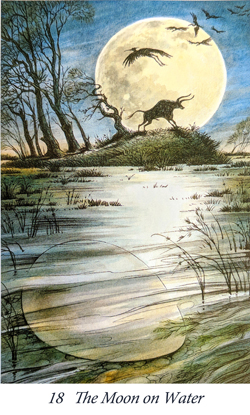
The Moon on Water card in the Wildwood deck explores the fertile creative ground of the subconscious mind. There isn’t an ounce of trepidation here. The subconscious should be wholly embraced and worked with as an equal partner in your achieving your goals.
The Moon on Water encourages using the power of the subconscious mind to gain a insights into human reality. The authors’ closing thoughts is to encourage us “to wrestle with the concept that consciousness is not within you, but that you are within the consciousness of the universe.”
Red Tarot
Red Tarot is a book without a deck, with a goal to reframe tarot into a decolonial and re-Indigenization perspective. To quote the author, “Red Tarot offers a visual framework for interpreting the tarot in a manner that perceives, disrupts, and rejects conditioned colonial consciousness.”
The Moon card in the Red Tarot explores how colonizers dehumanized people from other cultures by likening them to animals, and therefore there is a significant reclamation in progress when those with this history embrace their primal animal-like qualities as an integral aspect of their whole selves. When we learn from the nonhuman world we gain a deeper understanding of our own humanity.
The Moon is a call to freedom from the shackles of domestication, and reminds us that freedom must be worked for and reasserted over time. Every day, we endure the weight of historical oppression, yet we continue to move forward, guided by an inner and higher force of freedom.
Sufi Tarot
Sufi Tarot shows us the teachings of the Sufi branch of Islam, focusing on middle eastern cultural teachings.

The Qamar card of the Sufi deck leads us towards doing the work in order to achieve clarity within ourselves. It’s about emptying ourselves so that we are capable of receiving Divine truth. This requires doing the inner work to clear out all that is unnecessarily filling you up.
Opening ourselves to Divine truths in this fashion can also open ourselves to absorbing other, unwanted energies around us. It’s important, then, to figure out how to capture the Divine while allowing everything else to pass through. Do this by trusting your instincts and tapping into your inherent wisdom.
The author gives us two questions to contemplate:
- “How do I protect myself from others’ energies?”
- “What inner work must I do to clear my own impressions from the past?”
Summary
In conclusion, The Moon card endeavors to encourage us to understand our existence with more clarity. To understand our own minds and accept all parts of ourselves. And to wonder about the greater scope of existence; try to understand what is beyond our physical senses; try to understand what lies before us after death.
This is going to involve work on your part. You can explore your mind through therapy and various types of meditation. And you can explore the greater concept of reality by studying various religions and spiritual teachings. Most of all, this will involve you taking a lot of time to sit and think on these questions.
I’d like to hear from you. What is your experience trying to understand the unknowable? What has been your experience delving into the subconscious? What tips of tricks do you have working towards integrating your subconscious as an equal partner? What is your theory on existence that is beyond our senses? Leave a comment.
Interested in my experiences? You can watch my response video.
Sources
Primary sources are the books included with the decks for the Urban Tarot, Light Seer’s Tarot, Brady Tarot, Wildwood Tarot, and Sufi Tarot, plus the optional “Book of Maps” for the Spirit Keeper’s Tarot’s Vitruvian and Revelation editions. I also referenced the following books:
- Holistic Tarot by Benebell Wen
- Seventy-Eight Degrees of Wisdom by Rachel Pollack
- Golden Dawn Ritual Tarot by Chic Cicero & Sandra Tabatha Cicero
- The Tarot: A Key to the Wisdom of the Ages by Paul Foster Case
- The Book of Thoth by Aleister Crowley
- The Haindl Tarot by Rachel Pollack
- Red Tarot by Christopher Marmolejo
 Tarot Compass
Leave a comment