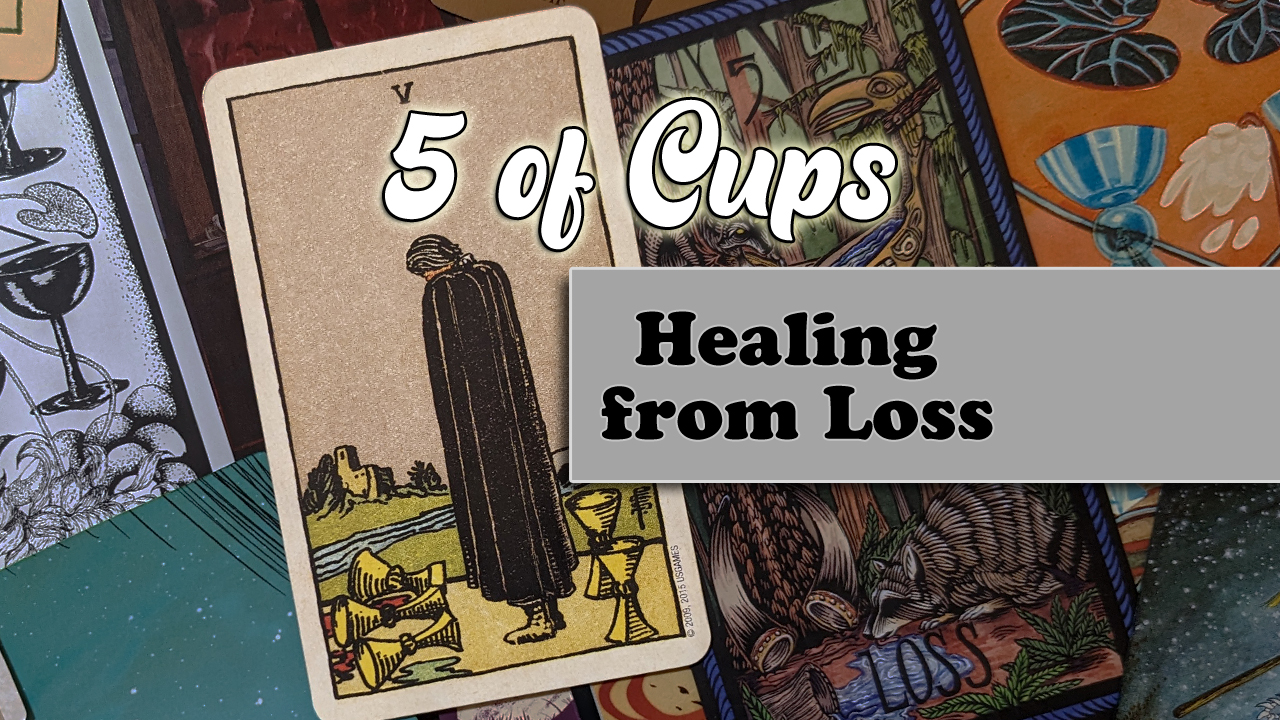
When we explore the symbolism of the Five of Cups we can discover how to ride the waves of grief after a significant loss and how to best approach the path to recovery.
The Five of Cups is part of the Minor Arcana, which means the lessons it’s teaching are about experiences we all encounter as we live our life. Within the Minor Arcana, the Five of Cups is a numbered card, which means it is one of the experiences we could have as we work towards achieving our goals. When we find ourselves in a situation, we can pull out the card that represents that situation and see what lessons we can find within its teachings. The Five of Cups is about our experience with loss.
The number 5 is an inflection point on our journey towards our goals, a moment of severe change. The suit of Cups covers our emotional experiences while working on goals. When we combine the number 5, meaning severe change, with the suit of Cups, covering our emotions, this card is then a representation of our emotional experience when a severe change occurs while we are working towards our goals.
The change that occurs is severe, meaning it is harsh, mechanical, and emotionless — a natural consequence of the laws of nature. Our instinctual emotional reaction to this kind of change is to feel hurt in some fashion. We can feel a deep loss as our plans disappear before us.
What are some plans we can lose that will hurt us deeply? Losing your job, for instance, disrupts your career plans and creates a host of emotions including shame from being let go, anger for being discarded, and fear of financial security. Traditional interpretations of this card often revolve around changes in relationships, such as a loss of love, friendship, or a threatening disagreement.
The lessons we are going to learn from the Five of Cups is how to best manage our emotional reactions when faced with severe change.
Let’s see how the different decks approach the lessons of the Five of Cups.
Rider Waite Smith
We’re going to start off with the Rider Waite Smith deck, the deck that is the major player of modern tarot philosophy. This particular deck sheds light on various western cultural teachings from the middle ages to the late 1800’s.
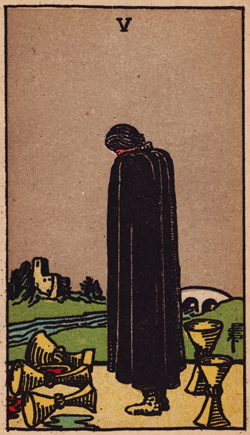
The Five of Cups in the Waite Smith deck focuses on the overwhelming emotional experience of sorrow. It can cause us to close ourselves off and dwell on the emotions. And that’s OK. Taking time to fully feel all the feels is an important part of processing grief. Sometimes we may be psychically wounded and so it would be a good idea to retreat to a safe place and take time to fully recuperate.
The important thing Waite & Smith want us to remember is to not get lost in our sorrow. We shouldn’t lose sight of what we have when processing our emotional reaction to our losses. Take a balanced approach between fully feeling the grief and retaining appreciation for what you have.
Sometimes we can get so wrapped up in our grief that we forget what we have and risk losing even more. Sometimes we neglect important maintenance chores (like paying bills, watering the plants, sometimes even eating!), or we neglect or hurt the people closest to us, all causing more aspects of our life to suffer.
We can minimize the risk of further losses by taking a balanced approach to processing grief. Allocate time to feel all the feels, allocate time to recuperative activities that will promote inner healing, and allocate time to maintaining what we have so we don’t lose that which is important to us.
Remember: Balanced. Don’t get wrapped up in the grief, but also don’t get wrapped up in avoiding it. The grief needs to be felt and processed.
Urban Tarot
Urban Tarot shows us how the lessons of tarot apply to modern day-to-day life as witnessed in New York City.
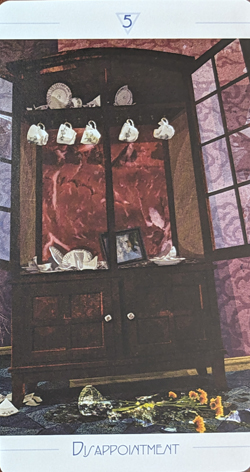
The Five of Cups in the Urban Tarot deck is titled “Disappointment”. It focuses in on our emotional reactions to the loss of a companionship that you had hoped would last. Human beings are very social creatures, so our relationships with others are extremely important to us. The loss of a partner could cause such a powerful emotional reaction that it feels like an open chest wound.
The scene pictured is the aftermath of emotions that exploded. The primal subconscious burst forth and took the reigns, choosing to physically lash out in order to express the deep pain in every way possible.
Don’t doubt how important our connections to other people are. It’s an integral part of the human experience making many of our core emotions tied to our social life. A loss of connection can cause an emotional explosion.
As a side note from me, emotions that take over your decision making capacity and cause physical damage, or cause you to cut into others’ psyche is not acceptable. If your emotions cause you to behave this way, it is your responsibility to put in the work on your inner self so your that your subconscious can reach a peaceful state.
If someone in your life behaves this way, protect yourself and distance yourself from them. You cannot heal the inner pain they have that is triggering these outbursts. They have to choose themselves to find the pathway to peace.
A peaceful life is possible. A once volatile subconscious is capable of finding peace — I know, because I managed to soothe my own disruptive subconscious. Finding peaceful companions is possible, they are out there. You do not need to tolerate explosive behavior from others — I know, because I managed to navigate my social circles and create a peaceful core set of companionships.
I used tarot as part of my efforts to soothe my disruptive subconscious. The reason I created this project of documenting tarot’s teachings about life was to make it more accessible to others so that you, too, can soothe your subconscious. I want to help. Ask me questions and I’ll do my best to answer.
Alright, side note concluded. Back to exploring the Five of Cups.
Light Seer’s Tarot
Here is the Light Seer’s Tarot, which I find addresses western mysticism through a modern lens, making it more up front and understandable to the masses.
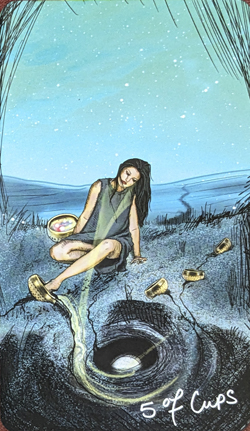
The Five of Cups in the Light Seer’s deck steps back from exploring the loss of a relationship to instead the loss of a dream. Losing a relationship is just one type of dream we have. We also have big dreams like a career or a family, and smaller dreams like accomplishing some goal. When those dreams are dashed we can be left feeling crushed.
The Light Seer’s deck is cautioning you that spending too much time ruminating on the loss of our dream can cause our life energy to spiral down the drain. Don’t lose sight that you still have a future before you and have faith that you can mold it into a new, albeit different dream.
Spirit Keeper’s Tarot
The approach of the Spirit Keeper’s Tarot is to personify each card, as if there is a spirit entity that is represented by each of the 78 tarot cards. You approach understanding a card as you would trying to understand a person who will have their own goals, motivations, and methods for working with others.
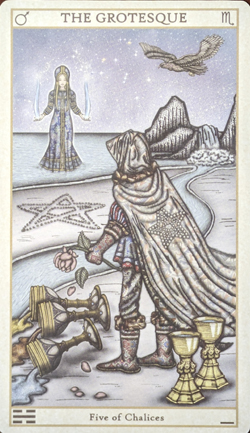
The Five of Chalices in the Spirit Keeper’s deck is personified as a spirit called “The Grotesque”. This spirit has an immutable trait that they conceal from society because it causes the average person discomfort. But this trait is also a source of power.
The Spirit Keeper’s deck shifts the focus from the number 5 being interpreted as change that occurs to a person, to instead the advanced interpretation that the change represented by the number 5 is the strength to enact change. True freedom is realized when you have the strength to change the conditions surrounding you.
The spirit of The Grotesque takes their trait society doesn’t accept and changes it into a source of power. Transforming a disadvantage into an advantage. The Grotesque mastered this transformation and has become so powerful that the average person would interpret their power as grotesque. The Grotesque can be called upon for support and guidance by those with a disappointing immutable trait and not yet empowered by that disadvantage.
We may interpret parts of ourselves as grotesque and try to hide it from others in fear that anyone who knew our true selves would reject us. A fear of rejection can be disabling. The anguish of rejection can be all consuming. At our very core we can question if we are truly lovable as our true selves. However, what we currently see as grotesque about ourselves now can, with time, be transformed into a source of power.
The Spirit Keeper’s deck also connects us to the spirit entities, the Rusalki, originating from Slavic folklore. A rusalka can be called upon to help transform the conditions surrounding you, especially for those who are women who have been wronged.
Haindl Tarot
The Haindl Tarot was one of the first to use tarot as a tool to study myths and traditions of various cultures around the globe.
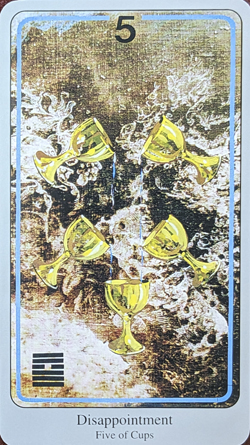
The Five of Cups in the Haindl deck is titled “disillusionment” because the loss of a dream is actually the gaining of a better sense of reality. A veil of illusion has lifted allowing you to see more clearly how the world works.
Losing the illusion of something we liked or wanted does most certainly bring pain. But, our goal in life should be to see and understand reality better, not to be engulfed in illusion. So, while we process our pain, we should also keep in mind that it is a good thing we’ve taken a step further from the illusion clouding our understanding of reality. The ability to perceive existence with increased accuracy is part of the pathway towards enlightenment.
Haindl Tarot was the first to attempt including the eastern I Ching within the western tarot. Instead of cards, the I Ching has symbols of trigrams and hexagrams. The author does not try to match hexagrams to cards, but rather used the eastern teachings found within the hexagrams to compliment and extend the meaning of the cards.
The author associates the Five of Cups with hexagram number 9, Xiao Chù. The translations he had access to titled the 9th hexagram as “The Taming Power of the Small” (Whilhelm) and “Restrained” (R. L. Wing). The recently released translation by Benebell Wen titles it “Cultivate Gently.”
The author concluded the 9th hexagram meant that success lies in the future and the best course forward is to enact patience. It’s normal to want to force what we want to happen as quickly as possible, but the 9th hexagram encourages taking a gentle and patient approach.
The translation by Benebell Wen indicates that the pathway to success is through small wins accumulating steadily over time. These small actions may seem like being passive, but there is strength there. The strength to stick to your convictions will allow you to overcome your difficulties. Choose gentleness, not forcefulness.
Brady Tarot
Brady Tarot is a study of the culture of various animals from North America. Studying the culture of animals helps us to zero in on universal lessons that apply to lives led by any species, not just humanity.
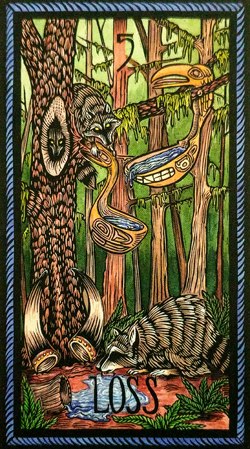
The Five of Horns in the Brady deck is titled “Loss” and focuses on the emotional experience of loss. What was lost is not important here, what is important is how we emotionally approach our loss.
We have a tendency to zero in on our losses and place all our attention on how to save as much as we can. This sort of reaction can be like putting on blinders and prevent us from appreciating what remains and seeing opportunities that could be better. And redirecting our energies towards that opportunity may be a better use of our time than trying to salvage from our losses.
Make sure your emotional reaction doesn’t put blinders on you. Retain awareness of your surroundings so you can maintain the ability to see the best path forward. And remember: the best path could be collaboration with others who share a similar loss.
Red Tarot
Red Tarot is a book without a deck, with a goal to reframe tarot into a decolonial and re-Indigenization perspective. To quote the author, “Red Tarot offers a visual framework for interpreting the tarot in a manner that perceives, disrupts, and rejects conditioned colonial consciousness.”
The Five of Cups in the Red Tarot focuses on the grief caused by the loss of love. Our current society leaves us left feeling disconnected, both from other people and a disconnection between the mind and spirit. This deep seated disconnection makes us ravenous for connection, which can make us impatient and try to fill that emptiness with whatever we can reach, which can be short lasting and leave us dissatisfied quickly.
When we lose a love, Red Tarot encourages us to fully envelope ourselves in our grief, to go all in and ride the wave as far as it will take us. This process will distill our desires to such a degree that eventually all that remains is the purified desire to connect with the Divine.
We go through repeated cycles of desiring connection, connecting with someone, then finding ourselves dissatisfied and starting the cycle all over again. Sometimes we connect with different people, and other times we stay with the same person continuously cycling through desire and dissatisfaction with them. If we take a moment to see that this repeated cycle is leading us to repeated dissatisfaction, then we can pause and navigate the path of our desires backwards to its source and realize what we truly desire is a connection with our creator. The Divine.
Through a connection to the Divine we can finally find fulfillment that is more than enough to keep us nourished. Seeking after our mortal desires is essentially just a substitute that will satiate for only fleeting moments. But, a connection with the Divine will moderate those highs and lows created when meeting a mortal desire wears off. We are then more fully enabled to engage in patience so we can wait until we can have an equal exchange of love with another in a more fulfilling, and safe manner.
Sufi Tarot
Sufi Tarot shows us the teachings of the Sufi branch of Islam, focusing on middle eastern cultural teachings.
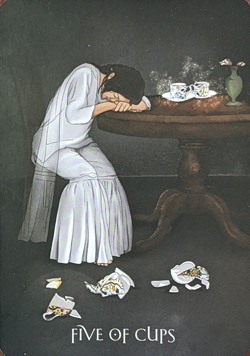
The Five of Cups in the Sufi deck is about the difficulty of accepting loss. About how there are times we focus on the negative and wallow in it. Sufi philosophy reminds us that loss is inevitable. So getting stuck in our losses would eventually lead to stagnation.
We should shift our focus from the loss to instead the opportunity for something else — something else that is potentially better. Sometimes we have to lose something in order to achieve something greater.
The 13th century Sufi poet, Rami, wrote, “Don’t grieve. Everything you lose comes round in another form. The child weaned from the mother’s milk now drinks wine and honey mixed.”
If a loss is bringing you downwards, try the Sufi practice of gratitude to help shift your focus towards what brings you peace. Take a moment to recall something that that brings you joy or peace. Focus on it, remember all the sensations of it: how it appears, how it sounds, how it smells, how it tastes, and how it feels. Let the gratitude for it fill your entire being, both your mind and body. You have had the privilege of experiencing this joyful or peaceful thing.
SEAMS Tarot
SEAMS Tarot stands for “South East Asian Myths and Stories”. Each card teaches about a story from one of the South East Asian cultures. Here, the Five of Cups card tells a story from Malaysia, about Mount Kinabalu on Borneo Island. Kinabalu means “China Widow”.
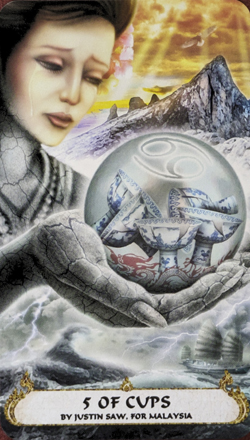
According to legend, the Emperor of China decided that whichever son of his managed to retrieve the magical pearl from the dragon that dwelled at the top of the mountain would be the one to inherit the throne. The 3 princes took on this quest, and one of them managed to snatch the pearl from the dragon! But he incurred grave injuries.
He managed to retreat with the pearl to a local village in the jungle. There he was rescued, and found love with the woman who nursed him back to health. While he slowly recovered from his injuries, he and the nurse fell deeper and deeper in love, eventually married, and had children.
The prince did not forget his quest, though. He still wanted to inherit the throne. So he took the pearl back to China and left a promise that he would send an escort to bring his wife and children safely to China.
Years painfully drifted by as the wife anxiously waited for her escort. She spent every day going to the coast to watch for ships. Eventually she started climbing to the summit of the mountain every day so she could see further into the horizon in hopes of seeing the ship that would bring her back to her husband. She eventually dies alone at the summit of the mountain.
The wife could not accept her loss. She refused to move on and obsessed day after day after day in a futile attempt to regain her lost husband and hope for a future with him in China. Her wallowing wasted her life away. She neglected her children. She sought no other social connections because she obsessed on just one connection that had gone missing. Her life stopped, and she stagnated, because she refused to accept the loss of her dream.
Summary
The Five of Cups explores how to best approach our losses and disappointments. We should make sure we do not wallow in the pain and get consumed with the emotional turmoil. But we also need to make sure to not ignore the grief, and take time to process it. Take a balanced approach. Make sure you aren’t being blinded by falling into the grief, nor be blind to the injury the loss caused.
The next time you are experiencing a painful loss, try rereading this post again and perhaps some of the lessons will jump out to you and help you figure out the best path forward. Remember to keep a watch out for potential opportunities the painful change has uncovered.
What are your experiences with loss? What worked for you to help recover from a painful loss? Share your story and what lessons you learned from the experience. Leave a comment.
Interested in my experience? You can watch my response video.
Sources
Primary sources are the books included with the decks for the Urban Tarot, Light Seer’s Tarot, Brady Tarot, Wildwood Tarot, Sufi Tarot, and SEAMS Tarot, plus the optional “Book of Maps” for the Spirit Keeper’s Tarot’s Vitruvian and Revelation editions. I also referenced the following books:
- Holistic Tarot by Benebell Wen
- Seventy-Eight Degrees of Wisdom by Rachel Pollack
- Golden Dawn Ritual Tarot by Chic Cicero & Sandra Tabatha Cicero
- The Tarot: A Key to the Wisdom of the Ages by Paul Foster Case
- The Haindl Tarot by Rachel Pollack
- Red Tarot by Christopher Marmolejo
 Tarot Compass
Leave a comment