
The Three of Cups is a tarot card that celebrates connections and shared joy. This post explores how different tarot decks interpret this card, each adding unique insights into what it means to celebrate together and share emotional experiences. The various differing interpretations will deepen our understanding of this joyful card.

The Three of Cups is part of the Minor Arcana, which means the lessons it’s teaching are about experiences we all encounter as we live our life. Within the Minor Arcana, the Three of Cups is a numbered card, which means it is one of the experiences we could have as we work towards achieving our goals. When we find ourselves in a situation, we can pull out the card that represents that situation and see what lessons we can find within its teachings. The Three of Cups is about our exciting experience of gathering together and creating something new.

The number 3 is about an idea taking form. The suit of Cups covers our emotional experiences while working on goals. When we combine the number 3, meaning the formation of an idea, with the suit of Cups, covering our emotions, this card is then a representation of our emotional experience when an idea starts to take form while we are working towards our goals.
And what happens when an idea of ours starts to take on form? We feel rather happy about it! We’ve put in the work to bring something into fruition, and it worked! It’s time to celebrate!
This is actually a difficult card for me to cover in this project’s format, because all the authors I’m reading up on are like, “Yeah yeah yeah, this is a happy card, you know how to handle happiness. Just enjoy it. NEXT!”
But! I am going to continue to dive in and see what life teachings I can find. So, let’s see how different decks approach the lessons of the Three of Cups.
Rider Waite Smith
We’re going to start off with the Rider Waite Smith deck, the deck that is the major player of modern tarot philosophy. This particular deck sheds light on various western cultural teachings from the middle ages to the late 1800’s.

The Three of Cups in the Waite Smith deck focuses on the symbolism of abundance and community. It suggests taking time to celebrate your successes.
Time is continually moving forward, changing things as it does. Therefore, anything we have to celebrate about will be temporary. We need to take the opportunity to appreciate what we’ve got when we get it, because time will, inevitably, change it.
Despite the Waite Smith deck being the primary deck studied and written about for 100 years, there is notably a lack of substance written about the Three of Cups! Perhaps authors believe that all people know how to handle success and what to do while celebrating. Let’s continue on and see what insights other decks bring to the table.
Urban Tarot
Urban Tarot shows us how the lessons of tarot apply to modern day-to-day life as witnessed in New York City.

The Three of Cups in the Urban Tarot deck covers the bringing together of people and creating a relationship. This can be the coming together in friendship, or the beginning of an intimate partnership.
Friends should take time to celebrate each other. Birthdays are a perfect opportunity for this! When the birthday of one of your valued friends’ comes up, make sure you take the time let them know that you support them and want the best for them. Take a regular opportunity to rekindle that warm camaraderie.
When you’ve begun a new intimate relationship and everything feels so great and wonderful, remember that you are probably within the “honeymoon” period. Enjoy this period! It doesn’t last, but the memories of it sure are sweet! Take regular moments to fully feel all the feels, remember each touch, each smell, and the beautiful sights. You’ll appreciate it when in the future you can recall this memory with greater clarity.
When you’ve reached the future, take time to appreciate what you had in the past. If it’s a relationship that didn’t last, let the memory fade to being bitter sweet, where you enjoy the good times and grieve the bad. If it’s a relationship that has had it’s honeymoon period fade away, bring forth those pleasant memories into your mind and use them to give you bursts of rejuvenation and appreciation for the partnership you’ve created together.
Light Seer’s Tarot
Here is the Light Seer’s Tarot, which I find addresses western mysticism through a modern lens, making it more up front and understandable to the masses.
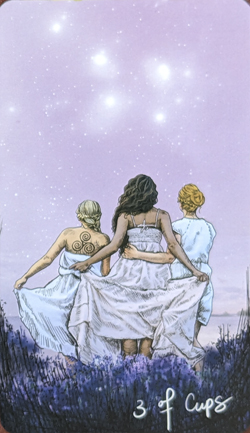
The Three of Cups in the Light Seer’s deck emphasizes that we should cherish the deep friendships we have. To quote the author, “… your companions serve as mirrors, allowing you to see who you really are through their eyes.”
The Light Seer’s deck cautions you to be careful if a disruption occurs in one of these cherished friendships. Look into yourself and see if this disruption is caused by a wounded part of yourself surfacing and causing problems. Put in the work to heal that wound, and make amends with your friend. Do not let protecting your ego get in the way of a friendship.
Spirit Keeper’s Tarot
The approach of the Spirit Keeper’s Tarot is to personify each card, as if there is a spirit entity that is represented by each of the 78 tarot cards. You approach understanding a card as you would trying to understand a person who will have their own goals, motivations, and methods for working with others.

The Three of Cups in the Spirit Keeper’s deck is personified as a spirit called “The Kindred”. This spirit can be called upon for assistance in gaining charisma to help draw friendships towards you, and grow a love for socializing to help maintain the friendships you have.
The Spirit Keeper’s Tarot reminds us of how important our connections with other people are, not just to ourselves personally, but to society as a whole. Our best friends, our good friends, our acquaintances all spread out to create a web of support. Even just making a brief positive experience with someone you momentarily engage with is a connection. Each one of these connections makes our web stronger, and therefore our society stronger.
Haindl Tarot
The Haindl Tarot was one of the first to use tarot as a tool to study myths and traditions of various cultures around the globe.

The Three of Cups in the Haindl deck is titled, “Overflowing Emotion.” The author shifts the focus from simply being joyful, to instead experiencing an excess of joy. So much emotional joy that it causes us to become unstable, that we could fall into a misery that is just has bad as the joyfulness was good.
The author wants to emphasize the cautions around emotions. Our emotions have a physical impact on us and can cause quite an inconvenience. Excitement can make it difficult to focus on something serious, and sorrow can make it difficult to even move! Anxiety can make our voice shake when we were hoping to convey confidence.
But we can’t shut ourselves off to our emotions. They really are like water, without emotions we’d dehydrate and die. And excessive emotion can cause us to drown. Just as we’re cautious around a swimming pool we intend to play in, we should be cautious of heightened emotions. Try to keep our wits about ourselves when in the midst of overflowing emotion. Don’t let it sweep us off our feet!
Haindl Tarot was the first to attempt including the eastern I Ching within the western tarot. Instead of cards, the I Ching has symbols of trigrams and hexagrams. The author does not try to match hexagrams to cards, but rather used the eastern teachings found within the hexagrams to compliment and extend the meaning of the cards.
The author associates the Three of Cups with hexagram number 28, Dà Guò. The translations he had access to titled the 28th hexagram as “Preponderance of the Great” (Whilhelm) and “Critical Mass” (R. L. Wing). The recently released translation by Benebell Wen titles it “Undertake the Great.”
The author concluded the 28th hexagram meant that there is a potential for greatness, but with a weakened foundation. So just as there is potential for greatness, there is potential it can collapse.
The translation by Benebell Wen conveys that when on a tipping point of change, we need to be careful to ensure that change will go in our favor. Even if things look like they’re going great, any change leaves one vulnerable to failure. Keep a watchful eye out. Don’t go for the quick and easy route. Don’t just follow any guidance blindly, we need to think everything through ourselves and make sure we truly believe in the path forward.
Brady Tarot
Brady Tarot is a study of the culture of various animals from North America. Studying the culture of animals helps us to zero in on universal lessons that apply to lives led by any species, not just humanity.

The Three of Horns in the Brady deck is called “Celebration” and showcases the power of community. All of the snow geese pictured are able to enjoy their lives because of the power of their community providing safety and a web of support.
We, too, are able to enjoy our lives because of the society we live in. Here, together, we are learning about the advanced concepts of tarot because our society helps us to have easy access to a safe place to rest and food in our bellies. If we didn’t have our society to help lift us up, we’d be spending all of our time managing safety, shelter and food. Society, our web of connections with each other, is what gives us time to explore the advanced concepts of life and existence.
There are those who have a closer bond then merely a connection. Their lives intertwine within each other like streams of water flowing together as one. Marriage-like partnerships are about blending together separate lives to flow together mostly as one. Many families and family-like friends function in a similar way, their lives flowing together and moving forward together.
Wildwood Tarot
Wildwood Tarot is an exploration of when human culture was more fully integrated with nature. Studying aspects of life from so early in the evolution of human culture helps us to zero in on lessons that have proved to be universally applicable through time.

The Three of Vessels in the Wildwood deck is titled “Joy” and focuses on the ability to actually connect with and feel joy. Some people have difficulty experiencing joy. Some people are avoidant of joyful feelings because of the inherent fleeting nature of emotions and they don’t want to feel the emptiness once the emotion passes. Others had the ability to feel joy snuffed out by the people closest to them punishing them for any sign of happiness.
Wildwood Tarot advises us to connect with joy whenever the opportunity arises because it is an empowering and healing energy. This joyful energy can radiate from us and spread positivity to those around us and create a warm and positive ripple through our web of connections. Your joy helps make the lives around you a little bit better.
Reconnect with your ability to feel joy if it has been suppressed within you. At every opportunity allow a little more joy to seep in. And gradually, over time, allow joy to fill your being and radiate to those around you.
Red Tarot
Red Tarot is a book without a deck, with a goal to reframe tarot into a decolonial and re-Indigenization perspective. To quote the author, “Red Tarot offers a visual framework for interpreting the tarot in a manner that perceives, disrupts, and rejects conditioned colonial consciousness.”
In the Red Tarot, the joy found in the Three of Cups is a resource of renewable energy. Tapping into joy rejuvenates ourselves and grants us more energy to continue forward. Creating joyful spaces helps everyone involved. Everyone’s joy helps us to tap into our own, and then we contribute to helping others tap into their joy. Afterwards, all of us can walk away with more energy than when we started.
We can celebrate our successes, and we can celebrate our survival. And we can use celebration to rejuvenate us after trudging through oppressive environments in our day to day lives. Celebration is a renewal of our energy, and a renewal of our vow to say “Yes” to life. To quote the author, “We need the Three of Cups to exchange exhaustion for elation.”
Red Tarot also recognizes that many people have trouble connecting to their joy. Our culture can dismiss joy as hedonistic selfishness. But… why? Why is it “improper” to take time to tap in to our positive energies and emotions?
My personal opinion is that some people have so much anger within themselves that it has blocked off their ability to tap into their joy. They then become jealous of witnessing others’ joy and try to snuff it out and apply a layer of shame to prevent the joy from coming back.
If you have trouble tapping into your joy, look into yourself to find the root cause. Does joy feel shameful? Who made it feel shameful? Can you dismantle that shame so you can open up your access to joy?
SEAMS Tarot
SEAMS Tarot stands for “South East Asian Myths and Stories”. Each card teaches about a story from one of the South East Asian cultures. Here, the Three of Cups card is represented by the Seven Wells Waterfall on Langkawi Island in Malaysia.
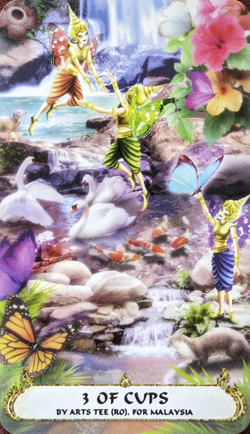
The Three of Cups in the SEAMS Tarot isn’t telling a story about a myth, but showing the result of the cultural evolution of the region. The waterfall is in Malaysia, yet shows flora and fauna from Malacca, Singapore, China and Japan. This blending of the native and the foreign coexisting peacefully is symbolizing how the friendship between nations is creating peace and abundance in the region.
Our web of connections isn’t just between individuals, but also between groups, and even nations. Working together can bring prosperity to all.
Summary
The Three of Cups is encouraging us to shamelessly tap into our joy and celebrate our successes. Time prevents anything from lasting, so we should always take the time to appreciate what we have when we get it. If you have trouble tapping into your joy, it would benefit you to set aside time to explore your inner self, and dismantle that which is blocking your access to joy.
The Three of Cups is emphasizing the power of friendships and community. Our connections with each other empower us all. Our good friendships should be cherished and nurtured.
What are your experiences with joy and celebration? Have you ever had trouble connecting with your joy? What are your experiences with friendship? Share your story and what lessons you have learned.
Sources
Books included with the decks for the Urban Tarot, Light Seer’s Tarot, Brady Tarot, Wildwood Tarot, Sufi Tarot, and SEAMS Tarot, plus the optional “Book of Maps” for the Spirit Keeper’s Tarot’s Vitruvian and Revelation editions. I also referenced the following books:
- Holistic Tarot by Benebell Wen
- Seventy-Eight Degrees of Wisdom by Rachel Pollack
- Golden Dawn Ritual Tarot by Cicero & Cicero
- The Tarot: A Key to the Wisdom of the Ages by Paul Foster Case
- Tarot Deciphered by T Susan Chang & MM Meleen
- Advanced Tarot by Paul Fenton-Smith
- Tarot Wisdom by Rachel Pollack
- The Haindl Tarot by Rachel Pollack
- Red Tarot by Christopher Marmolejo
- I Ching The Oracle by Benebell Wen
 Tarot Compass
Leave a comment